
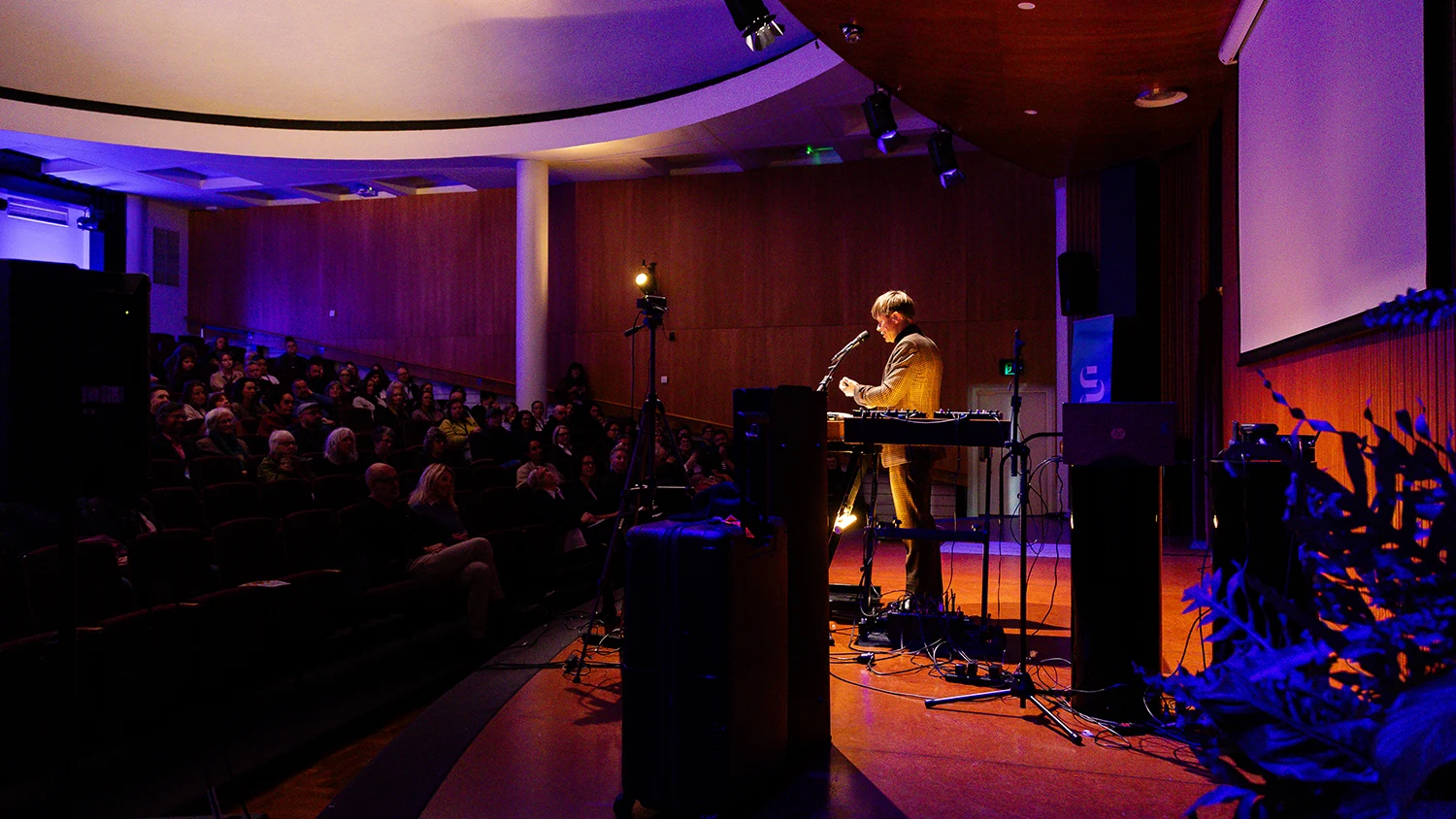
Photo: Alanah Brown Photography
From Radio NZ Nights on 16 October 2026
What makes a creative city? Anthonie Tonnon on the unique appeal of Whanganui.
Is Whanganui becoming a hotspot for creatives? As Festival of Design Aotearoa opened across Whanganui and Palmerston North, musician and urbanist Anthonie Tonnon joined RNZ's Nights programme to explore what makes the city such a compelling place for creative people and why smaller cities might have more to offer than we think.
When RNZ presenter Emile Donovan asked whether Whanganui was becoming a creative hotspot, Anthonie Tonnon's answer went well beyond its growing reputation as a place for artists, designers and musicians.
For Tonnon, who is also a public transport advocate and an enthusiastic Whanganui champion, the city's creative energy is closely connected to something surprisingly practical: its urban form.
The way Whanganui is laid out, the proximity of its people and places, and the opportunities for spontaneous encounters all contribute to a distinctive social and creative environment.
It's a perspective that speaks directly to the themes explored through Festival of Design Aotearoa, where design is understood not only as something we make, but as something that shapes how we live, connect and experience the world around us.
A city designed for chance encounters
One of the greatest strengths of Whanganui, Tonnon suggests, is its compact and centralised character.
Unlike larger cities that have expanded outwards over decades, Whanganui has retained much of its historic urban structure. Its central streets, civic spaces, hospitality venues and cultural destinations remain relatively close together.
This creates an environment where people regularly encounter one another without needing to make arrangements.
A visit to Drews Avenue on a Thursday or Friday might mean running into friends, stopping for coffee, or becoming involved in an unexpected conversation.
These seemingly ordinary interactions are, in Tonnon's view, an essential part of what makes a creative community work.
Ideas are exchanged, relationships develop and collaborations can begin through the simple act of being in the same place.
He describes this as a centralising effect, something he has experienced in larger international cities, but which Whanganui achieves on a remarkably accessible scale.
It's also a reminder that good urban design isn't necessarily about creating something new. Sometimes it's about recognising and protecting the qualities that already make a place work.
The unexpected advantages of a smaller city
The conversation also challenged a familiar assumption: that creative people need to live in major metropolitan centres to find opportunity, inspiration and community.
Tonnon reflected on growing up in Dunedin, moving to Auckland and spending years touring internationally, including in the United States.
Like many young creative practitioners, he had once imagined his future in cities such as New York or Paris, with Auckland serving as a stepping stone towards those destinations.
But his experiences travelling and eventually moving to Whanganui with his wife Karlya, changed that perspective.
Across the United States, he observed creative communities establishing themselves outside increasingly expensive major centres, finding new possibilities in smaller cities where affordability, accessibility and social connections offered a different quality of life.
He sees similar potential in New Zealand's provincial urban centres, including Whanganui, New Plymouth and Hastings.
The critical ingredient, he argues, isn't necessarily population size. It's the concentration of people, the ease of moving around and the opportunities to encounter others.
Whanganui's relatively compact urban footprint makes those connections possible without the distances and complexity often associated with larger cities.
And for creative people, those connections can be as important as access to major institutions or established cultural networks.
Affordability, architecture and creative opportunity
Affordability has undoubtedly played a role in attracting creative people to Whanganui.
Tonnon acknowledges that housing costs were an important consideration when he and Karlya began looking beyond Auckland.
But affordability alone doesn't explain the city's appeal.
Whanganui's architectural heritage and distinctive urban character are equally significant.
The city experienced substantial growth during the early 20th century, followed by decades of comparatively limited expansion. While that brought economic challenges, it also meant that much of its historic built environment survived.
Older commercial buildings, warehouses, streetscapes and civic spaces have provided opportunities for new uses and creative activity.
Tonnon recalls artists taking over old warehouses during the 1980s and 1990s, contributing to a creative culture that continues to evolve.
It's an example of how the built environment can support cultural development in ways that weren't necessarily anticipated when those buildings were first constructed.
Rather than replacing the old with the new, creative communities can find opportunities in adapting, reinterpreting and activating existing spaces.
That relationship between architecture, heritage and contemporary creative practice was also reflected throughout the Festival of Design Aotearoa.
Bringing big ideas back into civic spaces
For Tonnon, one of the most exciting aspects of the inaugural Festival was seeing the Whanganui War Memorial Centre activated as a place for public engagement with design and ideas.
He described the building as a modernist masterpiece, noting that its scale reflects a time when large civic gatherings were more common.
During the Festival, its spaces were brought to life with presentations, exhibitions and installations, including LEGO models of Whanganui buildings and streetscapes.
The centre’s Concert Chamber provided a setting for keynote presentations and discussions, reconnecting the building with its role as a place for collective cultural and intellectual exchange.
Tonnon also reflected on the pleasure of hearing different perspectives during the Festival, including a presentation by creative innovator Tom Eslinger.
What excited him most was the opportunity for people to engage with complex and eccentric ideas, and for a significant civic building to become a setting for those conversations once again.
It's an important dimension of the Festival of Design Aotearoa's purpose: opening up design thinking to wider audiences and creating opportunities for curiosity, exchange and participation.
A creative community that brings people back
Perhaps one of the most revealing moments in the RNZ conversation came when Tonnon recalled travelling back to Auckland for a performance after living in Whanganui for around a year.
He suddenly realised that he wanted to return to Whanganui for his social life.
It was an unexpected reversal of the assumption that larger cities naturally offer richer social and creative opportunities.
Despite having an established network of friends and collaborators in Auckland, he had found an equally substantial community in Whanganui.
That sense of belonging, built through regular encounters and shared experiences, is difficult to manufacture.
It develops through the interaction of people, places and opportunities over time.
And it's one of the qualities that makes Whanganui's creative identity distinctive.
A Festival for the city and the ideas shaping its future
The inaugural Festival of Design Aotearoa, held from 16–25 October 2026 across Whanganui and Palmerston North, provided a platform for exploring many of these relationships.
Through exhibitions, talks, workshops, performances, installations and opportunities to experience architecture and design firsthand, the Festival invited audiences to consider how design influences their everyday lives.
Tonnon contributed to the programme himself, sharing insights into his performance practice before closing the Festival with Cinematographer, his ambitious live performance combining music, storytelling and visual experience.
For him, the Festival was an opportunity to bring new energy into a city whose creative community has been developing for decades.
And his conversation with RNZ offered a useful reminder that the conditions supporting creativity aren't always the most obvious ones.
They can be found in the design of a street, the continued use of a heritage building, the affordability of a studio, or the unexpected conversation that happens when people cross paths.
As Whanganui continues to develop its identity as a UNESCO City of Design, these qualities offer a compelling foundation for thinking about what comes next.
Because a creative city isn't defined solely by the work its people produce. It's also shaped by the places, relationships and everyday experiences that make that creativity possible.
Listen to the RNZ interview
Is Whanganui becoming a hot spot for creatives?
RNZ Nights presenter Emile Donovan speaks with musician, urbanist and public transport advocate Anthonie Tonnon about the creative community in Whanganui, urban design, the appeal of smaller cities and the inaugural Festival of Design Aotearoa.
Listen to the full interview on RNZ
Originally broadcast on RNZ Nights, 16 October 2026.