
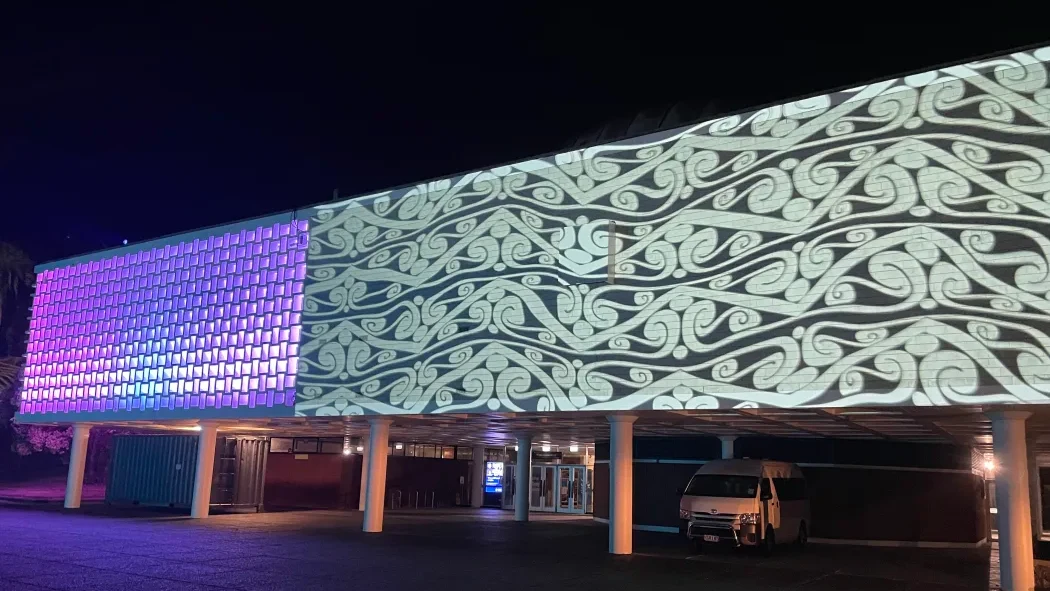
Photo: Supplied by Bill McKay
RadioNZ, Nine To Noon
Monday 2 November 2026
Original Article HERE
Bill McKay on adaptive reuse, architecture and Whanganui's creative energy
Architecture commentator Bill McKay joined RNZ's Kathryn Ryan to reflect on his visit to Festival of Design Aotearoa 2026, exploring adaptive reuse, architectural heritage and the creative energy shaping Whanganui.
Fresh from four days in Whanganui, architecture commentator Bill McKay shared his impressions of Festival of Design Aotearoa on RNZ, highlighting the possibilities of reimagining existing buildings rather than demolishing them.
McKay was among the festival's speakers, presenting a keynote on adaptive reuse at the Whanganui War Memorial Centre, a building he described as "probably the best example of modernist architecture in the country".
The greenest building is the one already standing
At the heart of McKay's discussion was a simple proposition:
"The greenest building is the one that's already standing there."
With construction and demolition waste making up a significant proportion of landfill, adaptive reuse offers opportunities to reduce environmental impact while retaining the architectural and cultural character of existing places.
McKay pointed to examples ranging from commercial buildings converted into apartments to former banks and post offices finding new lives as hospitality venues, accommodation and co-working spaces.
At Festival of Design Aotearoa, six practitioners shared their experiences of working with existing buildings. McKay distilled their presentations into six ideas: too far gone, risk, compromise, live in it for a while before doing anything, the need for a framework, and anything is possible.
Whanganui: a city of possibilities
Among the projects that captured McKay's imagination was the transformation of the former Gonville Swimming Pool by Frank Stark and Emma Bugden.
Once a ruin, the site now accommodates a garden within the former pool, guest accommodation in the changing rooms and a carefully inserted new home designed by Patchwork Architecture.
McKay also highlighted Eleanor Harvey McDouall's imaginative conversion of an old kauri boat into a tiny house, demonstrating how unconventional structures can be given entirely new purposes.
Beyond architecture, his visit included contemporary Māori art at the Sarjeant Gallery, a discussion with Māori public art practitioners, a heritage walk and a performance by musician Anthony Tonnon at the Royal Whanganui Opera House.
Young people, heritage and the future of regional cities
Reflecting on Whanganui's development, McKay was particularly enthusiastic about the energy of younger people bringing new life to heritage buildings and public spaces.
"Whanganui's got a really cool vibe."
He suggested that the future of regional centres depends in part on attracting and retaining young people, supported by education, creative opportunities and spaces in which new ideas can develop.
His advice to visitors was equally enthusiastic: take a break from the usual destinations and spend a weekend exploring Whanganui.
From modernist landmarks and reimagined buildings to galleries, performance venues and the historic Durie Hill Elevator, McKay's visit revealed a city where heritage and contemporary creativity continue to intersect.
Listen to Bill McKay's full conversation on RNZ's Nine to Noon, broadcast 2 November 2026 HERE
Transcript Below
Urban Issues with Bill McKay: Adaptive Reuse and Festival of Design Aotearoa
Speakers: Kathryn Ryan (host) and Bill McKay (architecture commentator)
Edited transcript based on the supplied automated transcription. Punctuation, paragraph breaks, place names and obvious recognition errors have been corrected. This is a lightly edited transcript, not a verbatim record independently checked against the audio.
Kathryn: Bill McKay is with us. Mōrena, Bill.
Bill: Kia ora, Kathryn.
Kathryn: Good to have you with us. Now, speaking of making the most of things, you're looking at it from the perspective of construction and construction waste. We know it's a shocking figure. I think it's something like 40% of all landfill waste.
Bill: There are estimates that are higher than that, even higher than that.
Kathryn: So how are you coming at things? Yes, you might be able to grab this or that to do a bit of something around the home, or make a bit of something around the home. But are you talking about something much more substantial?
Bill: What I'm mainly talking about is the Festival of Design Aotearoa, and I had a very enjoyable four days down in Whanganui.
My area was looking more closely at architecture and, as you say, adaptive reuse of buildings. So it was very interesting. Six, mainly architects, reported on projects that they'd done, and then I did a kind of one-hour keynote talk as well on the pros and cons of adaptive reuse.
Today, we're always looking for more sustainable ways of doing things. There's a building at our university that, rather than demolishing it, they stripped it back to the concrete skeleton and they did it up. They reckon they saved one year on the build and 25% of the cost.
So, you know, the greenest building is the one that's already standing there. It can save you time and save you money as well.
I had a bunch of other building types that I talked about as well, and these range from commercial buildings in Queen Street that have been converted to apartments, and then old commercial buildings in regional towns.
You know, former banks and post offices, because they don't exist in regional towns anymore, and they've been converted to tourism, hospitality, accommodation, co-working spaces, all of that kind of thing.
But I want to mention a couple of highlights in Whanganui.
I hadn't seen the new addition to the Sarjeant Gallery. I think it's been there for a couple of years now, and I was very impressed by a show of contemporary Māori art in there. Just one of the many shows that the gallery's new scale allows.
I also saw a discussion in the evening with three Māori practitioners in the public art area, and that was very interesting. Especially as they seem not to identify so much as artists.
"Toi is what we do," one said. You know, coming up with works that encompass history, environment, and the tangible and intangible things that make a place different from other places.
Actually, one thing I did notice down there as well is that a lot of the locals, the way they pronounce the W in Whanganui, "Whanganui"...
Kathryn: It's the local dialect.
Bill: Yeah, and it's quite different from the F that we use up here. And that's basically where the Pākehā pronunciation of the hard W came from. We're all familiar with the very long debate over the spelling of the name down there.
My talk was in a fabulous modernist icon, the Whanganui War Memorial Centre.
If anyone hasn't been there, it is probably the best example of modernist architecture in the country. And that's been fixed up as well in terms of seismic issues and things like that.
So, back to the adaptive reuse. There were six speakers: Mark Southcombe, who's an architect and lecturer at Victoria, Eleanor Harvey McDouall, Malcolm Taylor, Frank Stark, Ellen Young and Cansu İnal Kaynar.
After listening to them, I took away a phrase or summary from each one that I think can sum up adaptive reuse.
These phrases are: "Too far gone." "Risk." "Compromise." "Live in it for a while before doing anything." "You need a framework to approach it properly." And "Anything is possible."
And actually, I stayed in "too far gone" — the former Gonville Swimming Pool, which was a ruin when Frank Stark and Emma Bugden bought it.
Frank's a former director of the museum there. He also founded Ngā Taonga Sound & Vision, New Zealand's archive of film, television and sound, and Emma led the UNESCO City of Design application.
The last place in Whanganui was a 1950s house built out of nine, I think it was, concrete water tanks by a guy who cast them for a living. And they also owned a small-bore rifle range in Wellington, so they've got a bit of history in this adaptive reuse area.
And the Gonville Pool adaptive reuse is fantastic.
The pool is now a garden. I stayed in the former changing rooms, and Frank and Emma have got a new house that's been carefully inserted in there.
That's done by a young firm that I really rate, Patchwork Architecture.
And I think the guys from Spacecraft were part of another house that they did that's down in the city, the Dogbox. And that is one of my top three houses in New Zealand.
Three young graduates bought the cheapest bit of land that they could find. They found some trusses on Trade Me. They designed a whole house around that. I've talked about it on RNZ a few times.
The good news is you can stay in the changing rooms at the pools. That's on Airbnb.
And that phrase "anything is possible", well, that was taken to extremes by Eleanor Harvey McDouall.
She bought an old 1920s, I think it was, kauri boat, dragged it up on the riverbank, turned it on its side and fitted it out as a tiny house.
So you can stay there as well. It's on Airbnb too.
Kathryn: So, if the Festival of Design Aotearoa wasn't on, would you still go to Whanganui?
Bill: Yeah, I've given talks on similar urban issues throughout various New Zealand regions, and there is a bit of a sense of apathy in some. You know, that kind of sense of, "Oh, I wish someone would come along and do something."
But Whanganui's got a really cool vibe.
Scotty, a heritage planner there, took us all on a walk around the Drews Avenue part of town.
Lots of heritage buildings down by the river, many of which have been done up, turned into bars and cafés and co-working spaces by younger people.
And I've noticed in this country that my theory is, for a regional town to survive and adapt, you need young people in it because they do interesting and exciting things.
And to keep young people in town, that often includes providing tertiary education there as well, whether it's academic or whether it's more trade-based.
So I'd say Wellingtonians, take a break from the Wairarapa and spend a weekend in Whanganui. Two-hour drive.
Aucklanders, Air Chathams will get you down there.
First time I've flown in an Air Chathams plane that didn't go to the Chathams, but in a turboprop, so a bit different from the old Convairs that we used to fly in.
And I haven't even had time to mention a fantastic concert I saw down there by Anthony Tonnon in the equally fabulous Royal Whanganui Opera House, one of the few royal opera houses in the world.
He does great shows that mix spoken word, music, film clips, and his New Zealand shows have all sold out, and he's off to Melbourne and Europe now.
I've got a niece and a nephew in Melbourne, so I alerted them.
But as a public transport enthusiast, he also operates the terrific Durie Hill Elevator.
So you walk down a 200-metre-long tunnel, and then you get in a lift that goes up 60 metres, and there you are in the hilltop suburb of Durie Hill with a great view of Whanganui as well.
Kathryn: So what happens when you get south of the Bombay Hills, Bill?
Bill: I know!
Kathryn: I cannot believe that no one took you to the amazing Brutalist architecture building that is for sale there currently at the moment.
Bill: Oh, I had a good sneak around there. I visited that as a student when the Ministry of Works was in that building.
Kathryn: It's Wicksteed Street.
Bill: Yeah, yeah.
Kathryn: So it didn't make your top ten list, though?
Bill: No, it's not a house. Although I tried to convince my wife it could be.
Kathryn: It might be a house at some point.
Bill: Exactly.
And there's one last thing I want to sneak in for Aucklanders. Friday the 13th, Saturday the 14th of May, the Urban Art Village is on in Te Komititanga, which is the old Queen Elizabeth Square.
Kathryn: You meant November, didn't you?
Bill: November, yeah. So only a week away.
Kathryn: But student work, yeah, that's fantastic.
They also had their amazing artist studios events, which is a bit earlier in the year, actually, as well, which is another reason to go.
There you go, Bill. A convert to Whanganui.
Thank you so much, Bill McKay.
End of transcript.
Festival of Design Aotearoa 2026 took place from 16–25 October across Whanganui and Palmerston North, bringing together practitioners and communities to explore design, creativity and the future of our places.